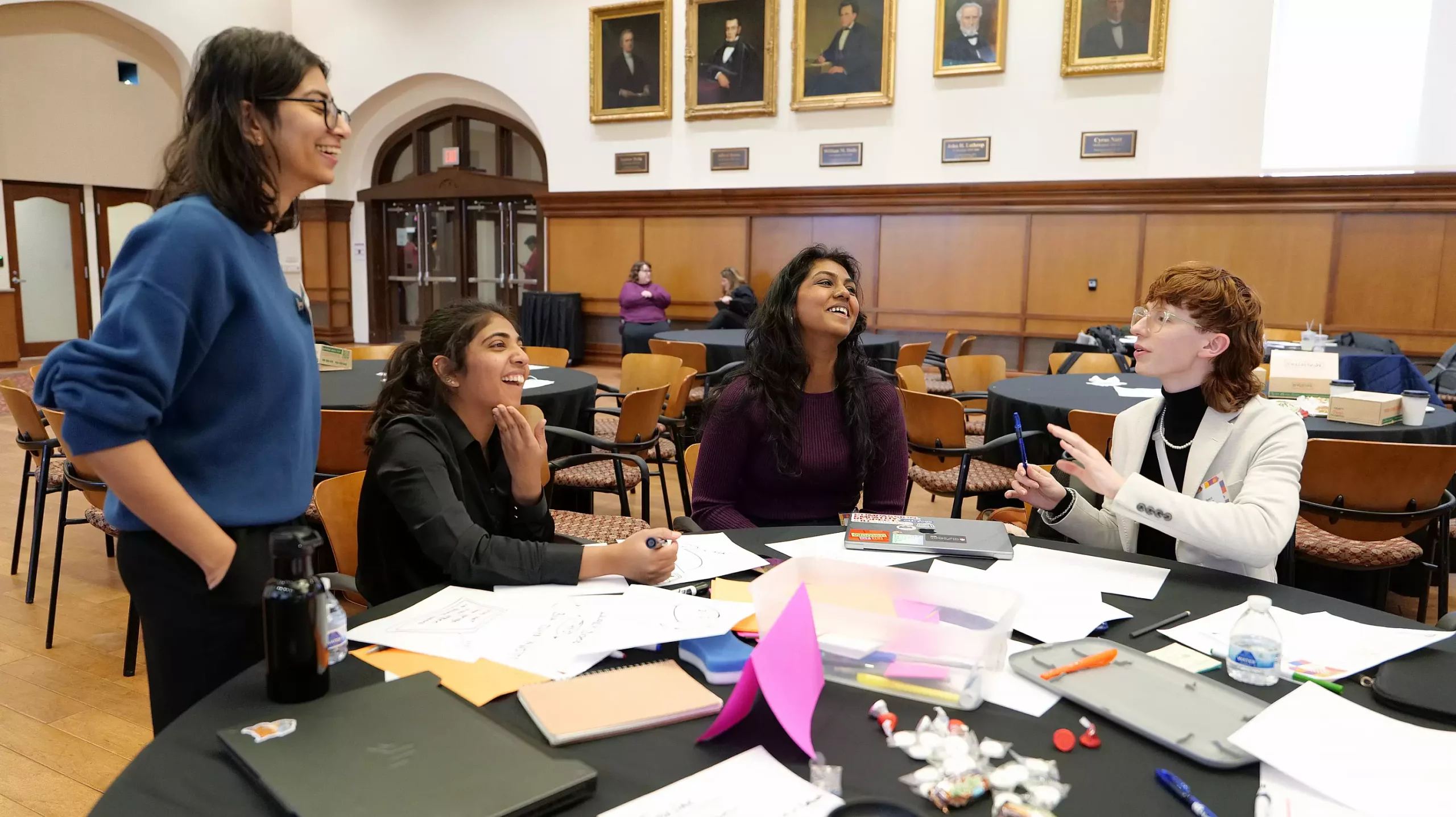
The team of Anvesha Gawade, Era Aggarwal, Apoorvaa Balasundaram and Reece Needham won the HCI/d Connect 2026 design challenge.
Photo by Chris Kowalczyk, Luddy School Communications.
Lucian Taylor, a second-year master’s Human Computer Interaction/design student at the Luddy School of Informatics, Computing, and Engineering, has difference-making plans for his career. The Luddy School and the HCI/d program provide tools to make it happen.
“I want to do something that helps people,” said Taylor, who hopes to get a Ph.D. in HCI.
The recent HCI/d Connect 2026 at Presidents Hall, held in conjunction with Luddy Career Services, was another step in that direction. Nearly 40 Luddy School students networked with a panel of HCI/d alumni and technology industry professionals before participating in a design competition focused on delivering a seasonally aware smart home experience.
“I want to learn something new by hearing from people in the industry talk about their jobs,” Taylor said. “That gives me new insight. I spend a lot of time in academia. Getting the other side of things is nice to hear.”

The event roughly coincided with the Luddy School’s 25th anniversary, said Austin Toombs, associate professor of informatics, who co-organized the event with Colin Gray, associate professor of informatics and HCI/d program director, and Career Services, because the HCI/d program has “been with Luddy almost since the beginning.”
“One of the things we’re most proud of is the HCI/d community,” Toombs said. “We have graduates all over the world in all kinds of roles.”
Emma Raver, associate director of employer relations for Luddy Career Services, said HCI/d Connect allows organizers to bring in experts from many different industries “to mentor our students and give them real advice on what (the experts are) seeing in their workspaces today” while allowing alumni to give back to the Luddy community.
“They love being here because they know it is what has helped them shift through all their different careers since they’ve left,” she said.
Working with faculty members such as Gray and Toombs in these events, Raver added, “ensures students get opportunities to professionally develop themselves.”
Development included the design challenge, which involved designing a smart home experience that intelligently understood changing seasons and could evolve its behavior over time while staying easy to use, controllable and respectful of privacy.
Specifically, students had to design at the level of systems and experiences, not individual devices. They needed a visual prototype and a storyboard or systems diagram, culminating with a three-minute pitch.
For Taylor, designing projects taps into his interest in “the problem solving aspect of things. You can go a lot of different directions with any project. It’s figuring out what you’re going to do and how to best serve your constituents, the vice president you’re designing for. Those are the things I gravitate to.”
Shreya Gururaj Kulkarni, another second-year HCI/d master’s student, seeks to eventually work for Apple as a product designer or a user experience designer.

Luddy School master's student Shreya Gururaj Kulkarni aspires to be a product designer or user experience designer.
Credit: Photo by Aaron Smith, Luddy School communications.
She said HCI/d Connect provided opportunities to get tips on how to network and how to more effectively apply for jobs by using strategies from attending alums.
In terms of the design challenge, Kulkarni embraced the team aspect in getting everyone “on the same page.”
“That’s fun to do,” she said. “You’re not agreeing, but at the same time, you’re trying to agree. I like that work. I like working on a team.”
So did Arjun Raghavan, another second-year HCI/d master’s student. He said designing requires getting people who think differently to “connect the dots.”
“That’s the challenging part,” he said. “You have to be very thoughtful about the concepts you’re dealing with.”

Luddy School master's student Arjun Raghavan embraced the opportunity to network at HCI/d Connect 2026.
Credit: Photo by Aaron Smith, Luddy School communications.
Raghavan, who hopes to start his career as a business designer with hopes of landing a leadership position, said his love of talking to people was a good fit for the HCI/d Connect environment.
“I want to know what the businesses are looking at and what they need from a business standpoint. Understanding it from a designer’s lens is the ultimate goal.”
*****
The current uncertain job market, Toombs said, is nothing new.
“We’ve seen multiple cycles from everything is great and everyone is hiring to everything is on fire,” Toombs said. “Industry shifts so much over time.
“We use this event to talk to alums and people practicing in this area to understand how we can position ourselves so we will stand out in the hiring process. It helps us better understand where we need to fill in gaps for companies or specific roles they are looking for. The real value is learning how people are thinking and practicing at their jobs at this moment.”
An alumni panel of Travis Ritchie, Simon Properties Group director of product design; Abby Stegall, Lowe’s product design; and Hannah Knight, Salesforce senior design lead, provided insight.

“One of the more valuable things we get from our grads,” Toombs said, “is sharing their experiences of what it’s like to be doing HCI work or research. They tell us what it looks like.”
Toombs and Gray use that information to update the HCI/d curriculum.
Knight emphasized the importance, upon arriving in the work force, of adaptability and being able to “pivot, pivot, pivot.” She also said she’s not worried that artificial intelligence will replace her.
“Getting AI to make something that needs to be made is horrendous,” she said. “It’s quicker if I do it myself. It still needs to come a long way.”
Stegall said AI is “horrible” when it comes to “matching context to what users want.”
“There are a lot of small decisions that a designer has to make,” Stegall said, “that AI can’t replicate. It doesn’t meet expectations.”
Ritchie said AI is used extensively at Simon Properties, which manages 90,000 retailers, particularly by using it for routine and maintenance tasks – what he called “keeping the lights on” – so designers could focus on what the companies wants them to do, which includes “experimental thinking.”
That insight was invaluable to Era Aggarwal, another second-year HCI/d master’s student.
“I want to get to know the industry point of view and what companies are looking for,” she said. “That’s helpful when applying for jobs.”
*****
Dave Martin, the web designer for David Martin Design who attended the Luddy School, talked about having a growth mindset and understanding yourself and what you want to do.
“Express yourself. Learn the language. Always be prepared. Know your audience. Talk about what you learned and how you’ve changed. Think long-term and where you want to be five and 10 years down the road. Surround yourself with people smarter than yourself.”
And, finally …
“Be human in an AI-driven world.”

John Skolak, founder and strategic consultant for 812 Labs, said the most important part of an interview, or any conversation, is to listen.
“I can’t stress that enough,” he said.
Skolak also said society has lost track of person-to-person connection and hopes, through his 812 Labs, which focuses on hospitality, tech and AI systems building, to “develop something that goes around that.”
Derren Hermann, an IU HCI graduate and user experience director at Nationwide Insurance, told students to, “Think about what you like and what you’re passionate about, and what you’ll be doing as a UX person.” He emphasized the importance of connecting with people, and following up with them, as well as focusing on human interaction, communication and working well with others.
“If you can’t deal with a lot of people,” he said, “then maybe a big corporation isn’t for you.”
That resonated with second-year HCI/d master’s student Apoorvaa Balasundaram, who hopes to become a product designer or an experienced HCI/d researcher. She wanted to know what skills she has learned in college that could be applied to industry.
The design challenge provided insight. Balasundaram was part of the winning team along with Aggarwal, Anvesha Gawade and Reece Needham.

Creative award winning team members were Arushee Thakur, Atina Sequeira, Devi Mahesh Kulkarni and Samiksha Pawar.
“Presentations are a way to condense a lot of thought into a small format,” Balasundaram said. “We usually spend a lot of time doing a lot of research. This was a quick challenge – we’re forced to do a lot of work in a small amount of time.”
In the end, HCI/d Connect 2026 was time well spent, Kulkarni said. As she enthusiastically put it, “Apple, here I come!”
Source: Luddy School of Informatics, Computing, and Engineering Indiana University